

Book Review: Volt Rush by Henry Sanderson
 Back in the winter of 2004, the Prof and I ticked an item off our bucket list by travelling from St Petersburg to Beijing on the Trans-Siberian Railway (strictly speaking, we took the Trans-Mongolian route). One of the abiding memories of this trip, apart from what -35°C really feels like on your face, was trundling past seemingly endless trains of Yukos oil wagons plying their way between Russia and China. Little did I know at the time that I was witnessing first hand evidence of a strategic vulnerability of the fast expanding Chinese economy, one which was to play a key role in the low carbon transition.
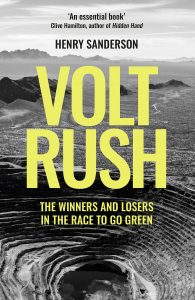
Until, that this, a couple of weeks ago, I was casually scanning the shelves of a second hand bookshop when I spotted ‘Volt Rush: The Winners and Losers in the Race to Go Green’ by Henry Sanderson. I hesitated for a few moments, concerned it might be yet another anti-green hit job, with the “winners and losers” subtitle and the slightly passive aggressive single inverted commas on ‘greener’ on the back cover particularly niggling, but the endorsement by Bill McKibben on the front cover salved those concerns.
Sanderson was a mining correspondent for the Financial Times and Volt Rush was inspired by him wondering what the supply chain for his Tesla actually looked like. Despite the subtitle, what follows is a pretty clear-eyed and objective description of how China has spent the last 20 years stealing a march on capturing the technology metals for the battery supply chain, not least to break its dependence on oil imports.
The lithium ion battery has radically changed the global economy and indeed society – we wouldn’t have all those pocket sized smart phones, sleek tablets and wafer thin lap tops without them. Sanderson rightly posits that an EV is essentially a battery on wheels, all the other bits are fairly routine. The sheer energy density of lithium ion batteries transformed electric vehicles from the trundling lead-acid milk floats of my youth to the sleek supercars of today. To me, the marmalade dropper in here is the revelation that Exxon Mobil had been behind the early development of lithium ion batteries. There is a neat parallel with the way Kodak had invented the digital camera, rejecting the technology, and watching as the prodigal son grew up and devoured their core market. Will history repeat itself? It might already have started.
The EV/battery race does start a long, long way back a long way and some saw it coming early. The Sage of Omaha himself, Warren Buffett, took at 10% stake in BYD just 4 years after I watched those Yukos trains on their way to China, and long before I’d ever heard of what is now the biggest manufacturer of EVs in the world. China’s belt and road and other initiatives have secured resources of critical battery minerals for the foreseeable. However, as with all gold rushes, there is skullduggery and dark deals. The conditions in ‘artisan’ cobalt mines in the DRC of particular concern, with some of the mining conglomerates not much better ethically.
If I had one criticism of the book it is that it is, ironically, a bit rushed in places – I occasionally skipped dense paragraphs of complex corporate takeover histories I really didn’t feel I needed to follow, while dozens of characters flitted in and out of the narrative without leaving much of a trace. The book is at its best when it allows the stories to breathe a little bit, such as the three pages on JB Straubel. Sanderson says it was Straubel who sold the EV idea to Elon Musk (Wikipedia has a slightly different but not incompatible origin story), became one of Tesla’s first employees, serving as Chief Technology Officer for 15 years, before quitting to find ways of closing the loops of the lithium economy by persuading us to empty our “WEEE drawers” of redundant devices.
The other issue isn’t Sanderson’s fault, as any book on a fast-moving technology will always quickly go out of date (and the fact I bought it second hand three or four years after publication exacerbates things). The rather hopeful chapter on Northvolt as a European battery giant is the biggest victim, as that company recently collapsed under controversial circumstances. And there is no mention of the next generation of lithium-silicon batteries which could expand storage capacity by a whopping 40% by replacing bulky graphite.
In summary, I feel Volt Rush filled in many gaps in my knowledge, wove many random threads in my brain into something resembling a coherent whole and gave me a number of great new anecdotes – I’ve already pinched the Warren Buffet one and the Exxon Mobil is primed and ready to be deployed in our Net Zero Business Academy session tomorrow. Great stuff.