

As gas prices soar again, are renewables really ‘unpredictable’?
It’s hard to think about anything other than the crisis in the Gulf (I tried, reader, but I failed). The main domestic manifestation is a sudden hike in gas prices as the Strait of Hormuz continue to be blocked to shipping. If you want an idea of how critical shipping is to the fossil fuel industry, approximately 40% of global sea cargo involves shipping hydrocarbons around the world.
The gas prices haven’t yet seen the peaks we experienced after Russia’s invasion of Ukraine (see below). But what struck me about this graph is the volatility – the world is highly dependent on a commodity which can easily double in price overnight and, in the case of a lengthy global crisis, go up by an order of magnitude.
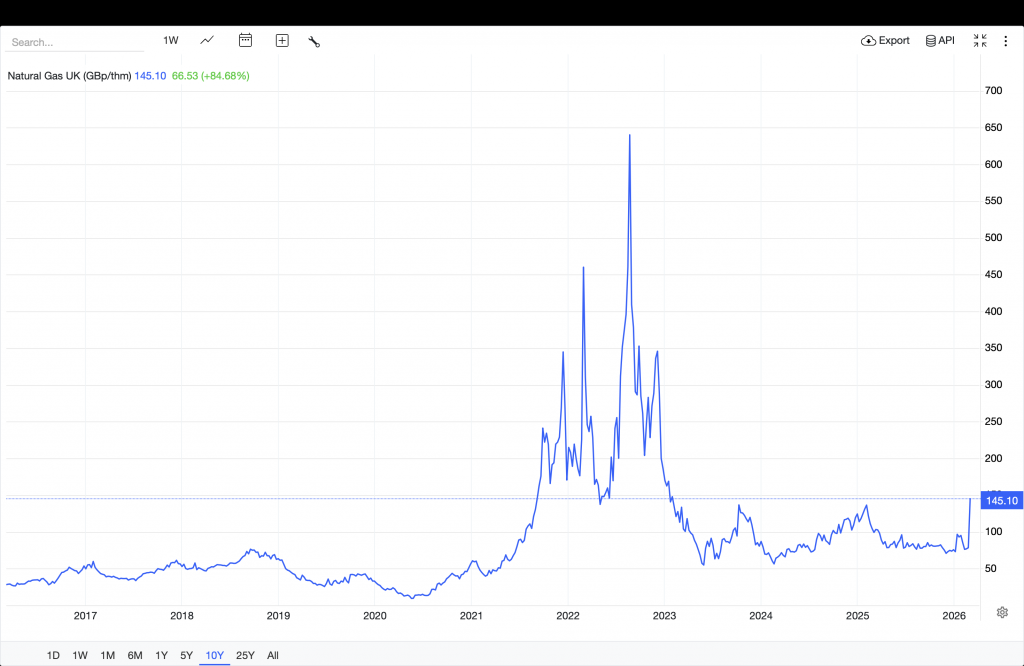
Source: TradingEconomics.com
Business thrives in a predictable trading environment. But what is predictable about the graph above? Yes, you can still buy gas at one of those peaks, but at what cost? How can you plan to invest in gas infrastructure if you haven’t a clue about your running costs? You can see how far the Trump administration has had to go to try and (fail to) boost the dying coal industry in the US; a clear case of disinterested investors putting their money elsewhere.
Renewables are often described as ‘intermittent’ or ‘unreliable’, but once you have purchased, say, a solar array, it will give you energy pretty much for free for 25-30 years, because no-one can fire a missile at photons. In the ‘sun belt’ where 80% of the world’s population live, solar energy is reasonably predictable. In these more temperate climes, it is trickier but not impossible to even out the peaks and troughs of generation. You might even have to burn a wee bit of gas now and then.
Voices on the right are calling for the UK to exploit remaining resources in the declining North Sea Oil & Gas fields, but very little exploration has taken place in the last decade, despite very generous tax breaks (the Government taxes profits, not investment). And of course all that oil and gas will be traded globally – this idea of ‘domestic hydrocarbons’ is for the birds and can be a liability not an asset.
The rational response to the volatility of oil and gas prices is to make our economies (and our electricity prices) less dependent on gas, not to make ourselves more dependent. I have mused before whether the current investment in renewables is already having an effect as we didn’t see much of an effect on prices after other geopolitical events in the last 6 months (eg Venezuela), and gas prices have risen in the last week but not by as much as I expected. I’ll be keeping an eye on those graphs to see what happens as the current crisis continues – maybe, just maybe, our labour is starting to bear fruit.