

The ‘going it alone’ on Net Zero fallacy
Returning to the outbreak of carbon culture wars, one of the memes used by the anti-Net Zero commentators is that the UK is ‘going it alone’. It sounds like a strong argument: why should we decarbonise while no-one else is? I had already started writing this blog when Paul Marshall, owner of the climate-sceptic GB News channel and manager of £1.8bn of fossil fuel assets wrote the following letter to the Guardian with a classic example*:
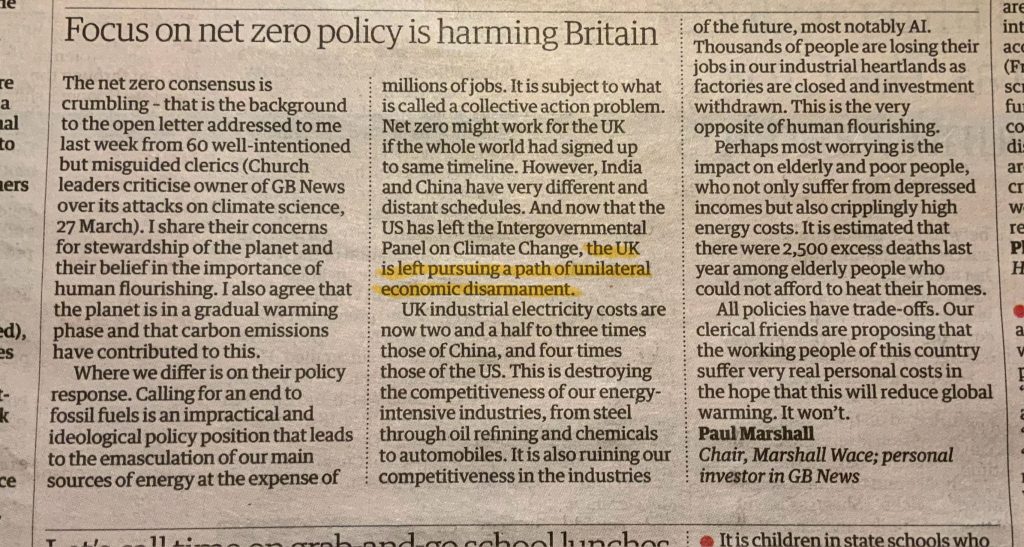
Is it true that we are going it alone?
First up, the presumption here is that decarbonising is a form of self sacrifice. Well, look back at those historic photos that pop up on your social feeds and look at the ubiquitous black grime on the buildings. That’s coal particles – and it was in everybody’s lungs as well as those facades. Was that good? No – I’d far rather live in a clean, modern, electrified society than keep burning stuff. Look at the natural colour of those same old buildings in our city centres today, think about your lungs, and give a ‘hurrah!’ for clean(er) energy.
But what about industry, as Marshall says? The UK has been losing heavy industry since the 1980s, long before climate change found its way out of academic circles and into the public discourse, and way before the Climate Change Act and the Net Zero target. The reason? Globalisation sent our manufacturing to low labour cost countries – otherwise we wouldn’t be able to afford all these gizmos we take for granted. A Forbes article from 2018 suggests that an iPhone would cost an eye-watering $30-100,000 if they were all made in the US (taking into account the fact it would become a low volume niche luxury). The energy required in the assembly line of a car is just 1% of its price on the dealer’s forecourt, and any Net Zero costs are a fraction of that – so if a big car brand pulls manufacturing out of the UK, it almost certainly wasn’t Net Zero wot dunnit.
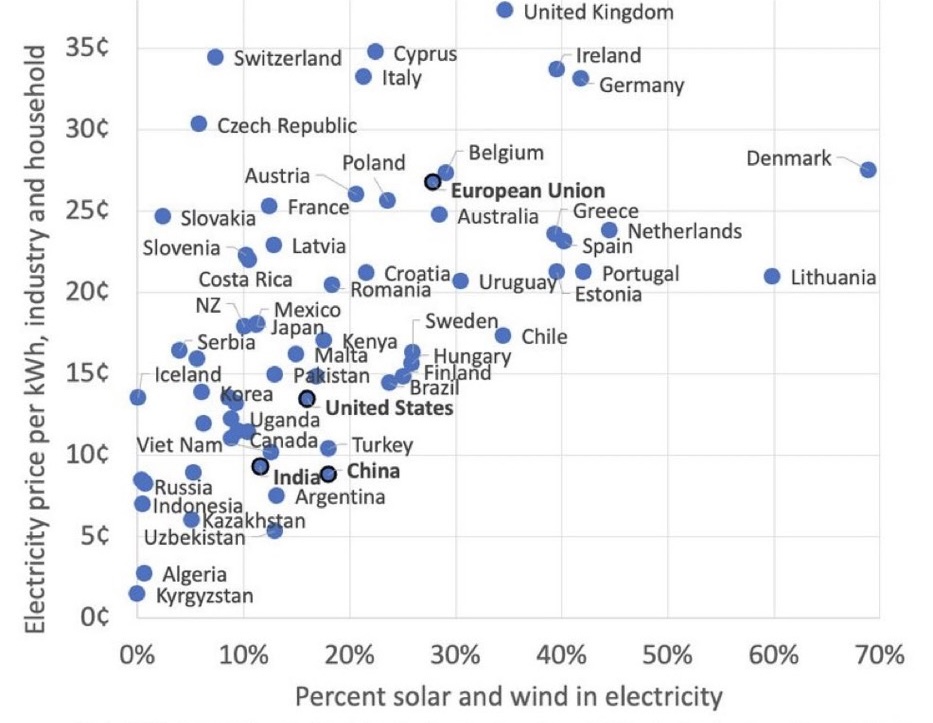
There’s no arguing with the fact that UK electricity prices are some of the highest in the world. The graph above was sent to me to ‘prove’ that the UK was pressing on with renewables alone, presumably by someone who hadn’t looked at it for more than a microsecond. I had to point out that it shows 9 countries with higher penetration of wind and solar on the grid than the UK, and, incidentally, all of them have cheaper electricity than us. While the bottom right of the graph is indeed empty, as detractors like to point out (“there is no cheap renewable energy!”), it’s remarkable how many points there are in the top left – ie some high carbon electricity systems are very expensive too. Looking at those points and the countries in the bottom left, we can only conclude that dirt-cheap fossil fuelled systems (pun fully intended) come at a real cost to society.
While EV sales continue to rise in a shrinking overall car market, the UK isn’t even in the top 10 in terms of % EVs sold. This leads to weird media debates about how we should loosen the EV mandate because ICE car sales are going down – a bit like saying we should ban vapes to protect the tobacco industry.
Investment in clean energy is dominated by China – more than the rest of the world put together. The US comes second with just less than half that, then Germany with a sixth of China’s investment, then the UK in fourth with a ninth (ie an 18th of the global investment overall). So other countries, including the supposedly anti-Net Zero US, are putting much more money in than us.
So the UK is definitely a player in the low carbon transition, and we should be proud of that, but we are far from the lone leader. At the risk of being the guy coining fallacies all the time, I call this the ‘going it alone’ fallacy.
* The Marshall letter has been expertly debunked by Simon Evans of Carbon Brief here. Evans uses the fact that 80% of the world’s population is currently covered by a Net Zero target to debunk the ‘going it alone fallacy.’ That’s true, but actions speak louder than words.