

The dumbest idea in energy politics…
In 1865, economist William Jevons noted that efficiency in coal-powered machinery didn’t lead to reduced coal consumption. Instead, counter-intuitively, efficiency could speed up consumption – in other words society would use more output rather than reduce input. This became known as the Jevons Paradox, or more colloquially, ‘the rebound effect’, and has been much debated ever since – almost entirely in terms of it being a problem.
I categorise two types of rebound effect: direct and indirect. Say you install LED lighting in your house, university or factory, which is more than 10x more efficient than the incandescent lighting of my youth. A direct rebound is if, knowing your lighting consumes much less energy, you might become careless about switching lights off, but you would need to leave the lights on 10 times more than before to wipe out the energy efficiency gains – and there just aren’t that many hours in the day. The indirect rebound comes from what you spend the money you save on. You could use it to improve the insulation in your house which could lead to further energy savings, or you could spoil yourself with a weekend in New York which would obliterate them. It is this last one which we have to be careful of.
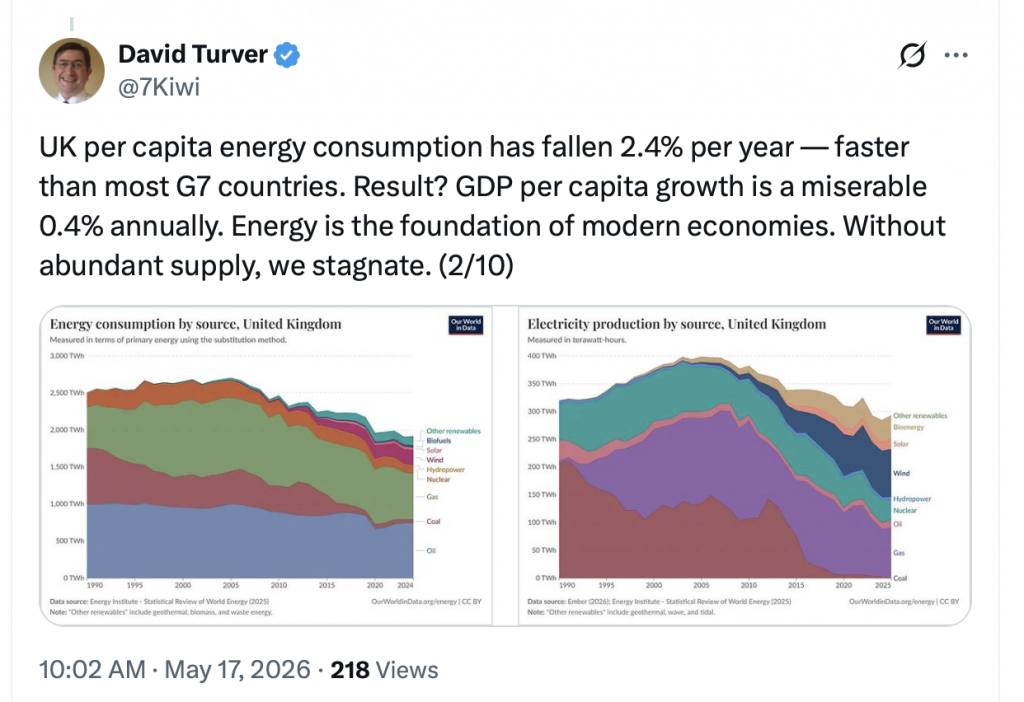
Recently, the small number of very noisy anti-renewables/anti-Net Zero zealots online have started arguing that energy consumption is a measure of societal progress (see pic). In other words, we should either be highly inefficient, or willingly exploit any efficiencies in a system to consume more, more, more. Under this definition, any action which saves energy is bad for society, unless you spend the savings on highly energy intensive products/services. Fly, baby, fly! Embrace the Jevons Paradox! Switching lights off is unpatriotic!
This mindset requires you to not only deny climate change and biodiversity loss, but pretty much the whole Second Law of Thermodynamics. The second law says any closed system (like the planet) will descend into thermodynamic chaos unless it is powered by a source of energy outside the system – in our case renewable energy. Seeing the consumption of fossil fuels as a measure of success is like setting ‘smoking more cigarettes’ as a life goal.
Nobody needs energy in itself. We need food & drink, lighting, heating/cooling, transport, communications, security, entertainment etc – and those things require energy, but the average Joe/Jo doesn’t care what type or how much. Their house will be just as warm if they use a solar-powered heat pump rather than an open coal fire, but the externalities in terms of polluting the planet (and themselves) are much higher. How is society improved by choosing the latter over the former? In the shorter term, promoting a high energy economy makes us more vulnerable to the kind of energy shock we are in right now.
It’s idiotic. In fact I would say it’s the dumbest idea I’ve heard in a long, long time. But these guys aren’t stupid. They know they are losing the low carbon transition battle and will throw out any chaff to try and slow us down while vested interests continue to cash in on the status quo while they still can. It is a sign that we are winning.