

After the ice, the fire – a third reflection on Iceland
 I’m back at my desk in Terra Infirma Towers post-Icelandic holiday, but it was an experience that won’t leave me quickly, so you’re getting another blog on the subject. Last week I wrote about our trip inside a glacier and how it seemed to be alive, and last week we visited the other half of Iceland’s legend, the fire.
We started off from Grindavik on the Island’s south west coast. The town has been so threatened by lava flows that the state has bought all the houses and is renting them back to their owners so they can up sticks at any time. A huge bulk of fresh black lava looms ominously at the edge of town, like something out of an early Dr Who episode.
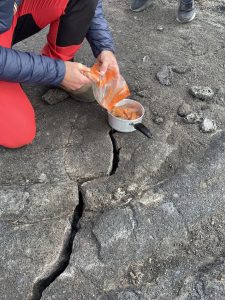
Our guide Gudni then took us on a hike up onto a slightly older/safer lava field filling a nearby valley. It was five years old but still has enough heat to cook some hotdogs using a pan with a fin attached the bottom to slot into a crack. The expansive, black, crunchy surface seemed devoid of life, but Gudni left a bit of bread roll in a crack for the resident mouse.
We went on to some hot springs which bubbled hot mud – like the lava and the constantly changing glacier the week before, this also felt very alive – Gaia Theory right before our eyes. As with the geysers we visited at the town that gave them their name, Geysir, the information panels mentioned that some of the springs were declining in activity while some were growing.
On the way back to Reykjavik, we passed a lava field whose rock hard bobbles were covered in moss. I asked Gudni how old it was – his reply of “800 years” made my jaw drop. A change that probably happened in a matter of weeks had rendered the land economically useless for centuries – and it would clearly take many millennia before you could, say, graze sheep on it.
This all reinforced the realisation that the Icelandic legends of elves, trolls and animism were based on a very real connection to our constantly changing earth – and how we should look after it. On a more prosaic level, Iceland has a national disaster fund to cover ‘acts of God’ such as the recent Grindavik eruptions. As we returned home to more wildfires, some post-drought flooding, not to mention an ‘uninsurable’ town, such a mechanism may become a necessity in the UK and beyond.