

Lessons on Political Leadership and Sustainability Part 1
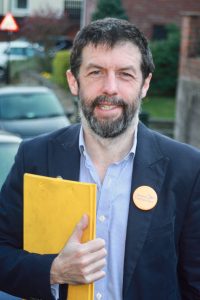 After my political career came to an abrupt end/pause this month, I’ve been musing on politics and Sustainability. So here’s my story of entering local government as a callow 33 year old back in 2004 and suddenly finding myself co-piloting Sustainability in a major city.
In our 2004 local election manifesto, my party, Newcastle Liberal Democrats, had stood on two clear environmental polices: ‘zero waste’ and ‘a carbon neutral city’, although notably we hadn’t set a deadline or much of a definition on either. We had adopted the zero waste policy from a campaign group called BAN Waste who had sprung up in response to a scandal where contaminated ash from a waste incinerator had been used to surface paths in allotments. ‘Carbon Neutral Newcastle’ was already running in the Council, but seemingly without any political commitment. We promised to turbocharge both.
In terms of organisation, my colleague Cllr Wendy Taylor took the Environment and Sustainability Cabinet position unopposed. Wendy had many years of political experience and, crucially, the respect of Council Officers. I slotted in as her deputy, providing technical knowledge while I learned the ropes. It was a combination that worked extremely well.
We started with waste, where we inherited a system of open crates for recyclates. Residents had to store the material in their house, sort it into plastic bags, put them in the crate, leave it on the kerbside and hope the weather didn’t misbehave. We looked at alternatives. BAN Waste pitched us a wheelie bin fitted with multiple drawers so residents could store waste outside their house and it would remain segregated. It looked incredibly flimsy and, unsurprisingly, hasn’t caught on anywhere. We went for a co-mingled wheelie bin with all the dry recyclables mixed together except for glass which went in a caddy at the top of the bin. BAN cried betrayal on the grounds of potential contamination, but on implementation, the recycling rate rose by 50% overnight.
Lesson 1: when in doubt, make it simple and convenient.
We wanted to start food waste collections and ran a trial with caddies in part of the city. However, our waste officers pointed out that we had inherited a 25 year residual waste contract which used in-vessel composters (IVCs) to stabilise the waste. The ‘grey compost’ that these IVCs produced was only suitable for spreading on top of landfill sites. Removing food from the residual waste stream would stop the IVCs working and open us to legal challenge.
Lesson 2: don’t lock yourself into long commitments which curtail future progress (we’ll come back to this in Part 2).
We planned to move our residual bin collections to a bi-weekly cycle to encourage the use of the recycling bin. Unfortunately a media storm blew up about this (remember the maggots on driveways which turned out to be fishing bait?), our opposition Labour Party put out leaflets listing all the diseases you could get from rats and we felt it would be prudent to put the idea on ice. Not long after they regained control of the Council in 2011, Labour did swap to bi-weekly collections and absolutely no-one complained – although I did enjoy reading their old leaflets out to them in the Council Chamber just to rub their noses in it.
Lesson 3: timing is crucial – sometimes you have to wait for a storm to pass before setting sail.
On the climate and energy side of things, we ran a project with Newcastle University to plot where the city’s emissions were coming from. I joined the board of various partnerships including Newcastle Warm Zone which insulated the properties of people in energy poverty and Groundwork South Tyneside and Newcastle who delivered a lot of projects at a community level.
Carbon Neutral Newcastle evolved into Carbon Neutral North East. The idea, as I’ve written before, was to allow people and organisations to offset their emissions and the money to be spent on local decarbonisation projects. We funded a small solar array (solar was still pricey back then), put extra funding into Newcastle Warm Zone for insulation installations, and contributed to a local tree-planting project. Unfortunately a national storm blew up around offsetting and the new ‘Gold Standard’ required projects to be run outside Kyoto Protocol countries which smashed our ‘local offsetting for local people’ model. To add to our woes, our Treasurer was found to have diverted CNNE funds to repay some personal debts, which knocked the remaining wind out of us, so we decided to call it a day. Interestingly, the new North East Combined Authority (NECA) has recently set up a very similar project almost 20 years later.
In about 2008, we started looking at district heating systems. Wendy and I visited schemes in Southampton and Birmingham which appeared to deliver low cost and low-ish carbon heat and power across those cities. Unfortunately there was strong reticence from the officer corps to this idea (I know what the beef was but won’t share it here) and we got locked into a cycle of ‘paralysis by analysis’ – a further study was always required. This may have inadvertently saved us from locking the city into a gas-fired future, if an efficient one, when the future is now electric.
Newcastle also became a hub for electric vehicle charging and we made quite a bit of cash installing EV chargers in other regional cities. We also pioneered using biodiesel in Council vehicles, although the emerging concerns about the Sustainability of biodiesel led to us dropping this as a priority.
One morning in late 2009, I was blearily pushing my newborn second child around the park in his pram when I got a call from the Leader of Council’s Office. Forum for the Future had awarded Newcastle “The UK’s Most Sustainable City”, beating Brighton and Bristol, the usual frontrunners. My immediate reaction was “We’re just getting started – how bad are all the others?” My second thought was “Don’t tell anyone, they’ll think it’s job done.”
My cynicism on the latter was misplaced – apologies to all concerned for thinking ill of you! The award galvanised action and all kinds of people emerged out of the woodwork to claim co-credit, including a few who hadn’t exactly been co-operative with us but suddenly reinvented themselves as eco-warriors. It worked – in 2010, we topped the league again, this time by a larger margin. It is a massive shame that the Forum stopped running this particular competition.
Lesson 4: success has 1000 fathers – just smile and let people claim credit.
Lesson 5: league tables/comparison with peers really works.
As a keen cyclist, I was painfully aware that our cycling infrastructure remained poor and provision was always an afterthought in any road scheme. I arranged for a group cycle of Councillors and Officers around the City Centre to prove the point. Unfortunately all the senior transport officers at the time found other priorities that day and backed out. Undeterred, we (as in Councillors) started drafting a cycle strategy to replace the existing one that had set the teensiest incremental targets. Given one of our number worked for Sustrans at the time, we had plenty of expertise. We set bold targets for cycling journeys and the outline strategy envisioned seven radial strategic cycle routes linked by a number of concentric routes, but we ran out of road to flesh it out.
Unfortunately in the 2011 local elections, we lost control of the Council back to Labour. In terms of Sustainability, we knew we were still in the early phases of our ambition and wanted to top not only national league tables but compete with the best in Europe. We had tried a lot of stuff, some of which succeeded and some of which failed, but the Forum for the Future accolades will stay with me until the day I die. In the next part of this series, I’ll reflect on trying to drive this agenda forward from the back seat where political Opposition sits.
Lesson 6: Political leadership can make a real difference – make clear commitments, but be prepared for failure as well as success.