

Are Glaciers Alive? More Icelandic Tales
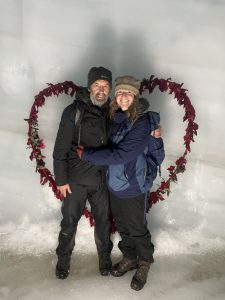 If you’re going to go inside a glacier, what kind of bus do you catch? A bus converted out of a NATO missile launcher, that’s what. These beasts have eight huge studded Tonka truck tyres, each with its own air hose so the driver can deflate them on the transition between the gravel approach road and the ice track so to get a grip on the rather precipitous climb up to the top. Once up there, and an indistinct distance across, we dismount by a tunnel mouth sunk into the ice below.
Inside the tunnel entrance, we’re each given a pair of slip-on chain crampons to allow us to tramp down into the heart of the glacier, dodging the cold water that showers down from moulins and which has an unerring ability to find the back of your neck.
Our guide explains that the glacier is in constant flux as if it was alive. The original tunnel, conceived during a night on the beers, was dug in a straight line, but now it bends in all directions. In fact, the glacier constantly tries to fill the tunnel, so the operators have to do preventative digging a couple of times a week to keep it open. We see the dark line of ash from the infamous 2010 volcanic eruption that stopped all air travel in Europe, and one about 50cm higher the result of a smaller eruption in 2011 – the equivalent of tree rings. As almost all of Iceland’s drinking water comes from these glaciers, the whole country relies on them being constantly topped up by each winter’s snows.
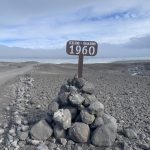 This, of course, is the rub. Near ‘base camp’ where we got on the megabus, there is a sign marking the extent of the glacier in 1960. Similar signs have been installed further up the ever lengthening gravel road, marking the edge of the ice in 1980, 2000 and 2020, but they broke protocol and put one in for 2025 as the retreat had accelerated to the stage that 5 years’ retreat today is equivalent to 20 years’ worth last century.
On the way back off the ice, our guide hosts an informal Q&A which quickly veers off topic from ice into Icelandic culture. The guide shows us Norse rune tattoos on his arms – one for protection in battle, another for good luck on his travels – while he’s not very religious, he nods to traditional beliefs. Karen asks him about elves and he talks about how they (and trolls) are felt to be part of the landscape. There is a strong element of animism in his responses – like the glacier, the natural world is very much treated as if it has consciousness and inherent rights. “Don’t touch the moss,” he warns us with a smile “please don’t touch the moss.”
Back in Reykjavik, we pick up a free English language newspaper. The editorial brims with outrage at a group of French tourists/4×4 influencers who had driven their pumped up Land Rovers cross-country through the interior of the country, openly treating the fines levied en route as an inherent cost of the jape. In a country where pulling up on a gravel verge by the roadside is illegal, this was beyond the pale.
As a ‘let’s work out what needs doing and just do it’ engineer, I’ve never really been one for woo-woo deep green philosophy, but maybe, just maybe, this Iceland trip is making me think just a bit deeper about the natural world. Is that glacier alive – metaphorically or literally? Is it just chance that it keeps trying to close the tunnel, or is it healing itself? Should it have the right to exist in law? Would treating it as a living thing make our symbiotic relationship more meaningful?
I’m doing a lot of mulling!