

Lessons on Political Leadership and Sustainability Part 2
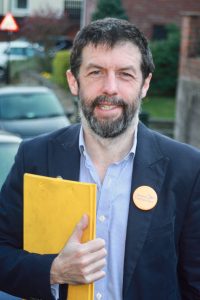 Last week, I reflected on lessons from my first seven years as a Newcastle City Councillor when I was Deputy Cabinet Member for Environment and Sustainability. This peaked in Forum for the Future designating the City, the Most Sustainable in the UK two years running. That acclaim didn’t stop us sliding back into Opposition in 2011. My boss for those first 7 years, Wendy Taylor, is an eminent oncologist and she moved over the health brief, while I became Opposition Spokesperson on Environment and Sustainability.
When the new Labour administration revealed their four priorities for the city, there was nothing on the environment. I made several efforts to get them to add a fifth priority, but the best we got was talk of a ‘cross-cutting theme’ or ‘a green thread running through everything we do’. On the latter, I pointed out that if you have a single green thread in a piece of embroidery, it does nothing to change the overall picture and you have to peer really closely at the cloth to see it – from a distance it is invisible.
This analogy was prescient as many of the projects we had left running – freight consolidation, district heating, to name two examples – withered on the vine. The cycle strategy was completed and approved by Council, before being quietly sidelined in favour of a number of isolated projects that didn’t join up. None of this was helped by the extraordinary turnover in Cabinet Members in environmental roles – I estimate I faced at least 7 individuals in the following 14 years. None of whom had any prior experience and they didn’t get much time to get to grips with the brief before being swapped out. In terms of holding them to account, I only managed to embarrass or anger them; I failed miserably to get them to take it seriously.
Lesson 7: It takes real leadership to drive Sustainability forward – lip service won’t deliver
In the 2018 local elections, I lost my seat by 12 votes. I promptly won it back in 2019 (by 247), but in my absence, something changed. Wendy had put a motion to Council declaring a climate emergency and setting a target of Net Zero by 2030. I was too busy winning my seat back to intervene and suggest that 2030 was more than a little ambitious, but, hey, after watering down the detailed commitments a bit, the Labour administration approved it. Not only that, the then Leader of Council stepped up to the plate and declared that this was now a personal mission for him. Staff were appointed, a plan was developed and, after 8 years of drift, we seemed to be moving forward again. And I was back as Opposition spokesperson.
Why did Wendy’s motion succeed when my efforts had failed? In the adversarial cauldron of party politics, any ‘win’ for us would have been seen as a ‘loss’ for the administration. Wendy’s motion gave them a springboard to change before being airbrushed out of history – all subsequent narratives referred to the amended climate motion, not her original.
Lesson 8: Leaders have to want to do Sustainability; there are ways of getting them to want to do it, but telling them to do it isn’t one of them
Unfortunately much of the new climate plan was predicated on the expectation that Central Government would provide the means to change. This meant we would get much-trumpeted pilot projects but no joined up thinking. There was a reluctance to take full use of the Council’s day-to-day powers on, say, highways or Council housing (making up 24% of the dwellings in the City).
For example, every new design of a major road junction designs had cyclists corralled into pedestrian crossings, rather than being given the kind of treatment cyclists would get in most continental cities. Best practice would have required little extra cost, just a different design mindset.
Another issue I kept raising was sustainable drainage – again we were getting a stream of new road designs that didn’t have any soakaways built in, even if it only meant dropping the level of tree pits so excess water could be captured before it hit the sewers. One time when I raised this, the Cabinet Member at the time retorted that I clearly hadn’t being paying attention as a rain garden had been incorporated into a city centre development. One. Box ticked, photo taken, job done.
Lesson 9: Sustainability must be embedded into mainstream activity and not just added ‘green bling’
Probably my biggest frustration was on residual waste. The In Vessel Composter contract we had inherited in 2004 was drawing to an end. The administration bought into a seven-Council consortium to build a new waste incinerator on Teesside, 40 miles away. The City’s recycling rate had fallen to 23% – we were back in the relegation zone of the national league tables.
A rebellious Labour member requested a ‘task and finish’ group to investigate ways of pushing the recycling rate back up and avoiding the need for an incinerator. Wendy and I readily joined her on the group and we held a series of ‘hearings’ to take evidence. The draft report produced by Council Officers could be summarised as “The Council is on the right track, but here’s a few things to consider” which we refused to endorse. In turn, the officers refused to produce a draft reflecting our true conclusions that the incinerator was unsustainable – we had to publish it our own. The administration dismissed our report out of hand.
Last summer, feeling that I might be running out of road as a Councillor due to ward boundary changes, I threw my Hail Mary – a motion to Council demanding we withdraw from the incinerator project. We had a classic debate – I pointed out this was locking us into an unsustainable path for 30 years and we would never meet the Government’s target of recycling 65% of waste by 2035. I ridiculed the claim of ‘CCS-ready’ asking while the incinerator may be ready for CCS, but will CCS ever be ready for the incinerator? My motion was narrowly agreed by Council, but the Council’s Cabinet rejected it again, saying pulling out would be more expensive than proceeding.
Lesson 10: Never choose an ‘easy’ option which locks the organisation into a path which is unsustainable in the long term.
And that was pretty much that. Writing this up reminds me how frustrating it is to be in Opposition compared to be in control. I did manage to get a few things moving faster than they would have otherwise, but fundamentally the people with power need to want to exercise that power. We effectively had three decidedly incrementalist Labour administrations, riven by infighting, and we got incrementalist improvements as a result. Ultimately, it was very frustrating.
Following the elections, the Council is now in a balance between my fellow Lib Dems (25 seats), Reform (24 seats) and the Greens (23 seats). Who knows what will happen next.