

The X Curve and Sustainability: A Reckoning Beckons
The news that the UK Government is considering tariffs on imported Chinese EVs seems to have raised eyebrows across the political spectrum. We’ve been told repeatedly that the UK’s EV mandate should be weakened “because uptake of EVs is not meeting ambitions“, so why are Chinese brands seen as a threat if they are not wanted?
The logical answer is people are happy to buy EVs at the right price. Of course the heavily subsidised state-run economy of China gives its emerging car industry many advantages, as do some of its seriously dodgy labour rights standards, but I’m typing this on a laptop made in China, surrounded by Chinese-made technology, and I’ve never heard anyone call for tariffs on consumer electronics (apart from Donald Trump and that’s not going well).
The longer view is that the EV/ICE transition is following a classic X curve made up of two S-curves (see below). Change happens rather slowly until various tipping points are met and then it happens very quickly. While we tend to focus on increasing demand to pull the green economy up its S-curve, the collapse of the brown economy will take no prisoners and businesses/economies will need to leap from one curve to the other before its too late. Think about how quickly Blockbuster disappeared from our high streets as streaming took hold.
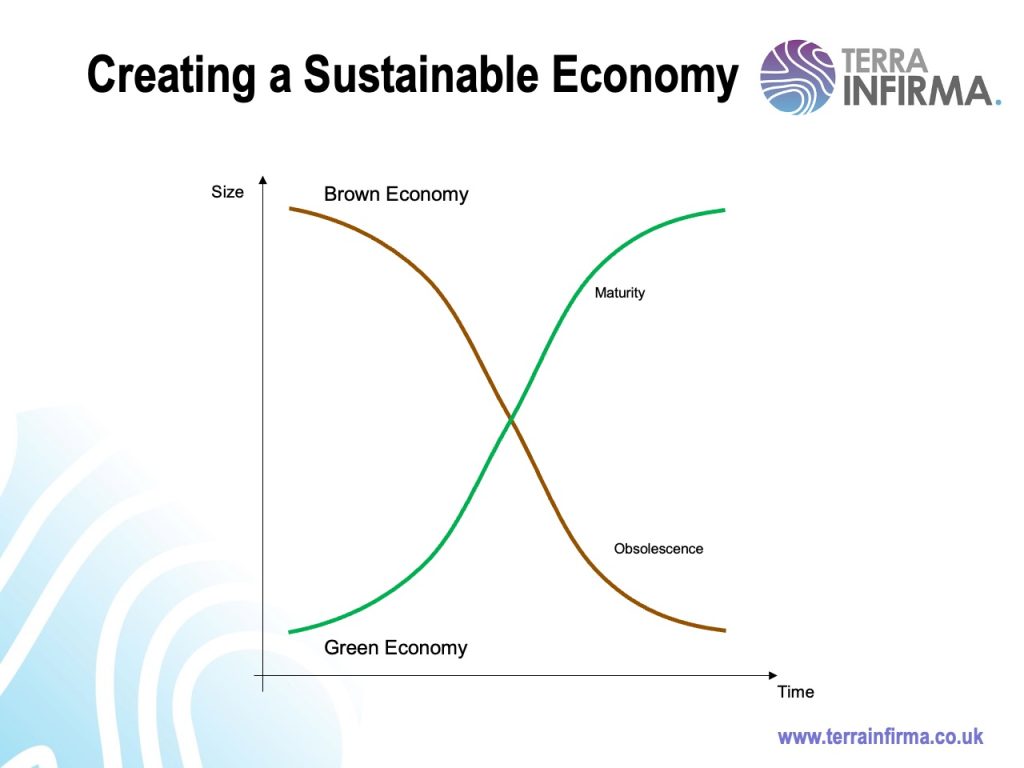
The fastest way to make this happen is to increase demand at different points in the value chain. For example, there is an emerging view that the UK Government should broaden its narrow focus on decarbonising the grid (ie Clean Power 2030) to increasing electrification as that demand will help pay for the grid transition and bring electricity prices down. An 80% clean grid providing a huge amount of energy will cut more carbon than a small 95% clean grid.
Likewise I was very taken with the ongoing negotiations between Nissan and Chery to manufacture the latter’s EVs using spare capacity at the former’s Washington (Tyne & Wear) factory. This would not only mean more UK-built cars and continued employment in a deprived part of the country, but would increase demand in the growing local EV component supply chain and bring down costs. That in turn will help satisfy the obvious demand for EVs at a reasonable price.
My fear is that vested interests are lobbying to prop up the brown economy, slowing the upswing of the green. Not only will that cause more carbon to be emitted, but when the inevitable crossover does happen, the UK economy will be ill-equipped to service demand and our motor industry (or others) ends up on the scrapheap. We need to find those paths to get footholds on that upward curve.